Home
News & Blog
Why Surface Preparation Is Critical in Robotic Welding and What You Lose by Ignoring It

27 November 2025
Articles
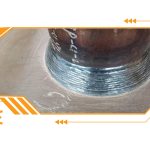
A Perfect Weld… On A Dirty Surface?
Robotic welding promises precision, efficiency, and consistent quality. But one critical variable is often overlooked: the condition of the surface being welded. Mill scale, rust, moisture, flakes⦠many manufacturers hope to achieve flawless welds without properly preparing their parts. The result? Visible defects, wasted materials, reduced productivity and the mistaken belief that the robot is âwelding poorly.â
The Hidden Costs Of Welding Over Mill Scale
Most manufacturers, especially in North America, skip surface cleaning because itâs seen as non-essential or too expensive.
Yet neglecting this step leads to a cascade of consequences:
Arc instability caused by non-adherent mill scale.
Irregular visual results: convex welds, increased presence of silica islands, underfilled welds.
Systematic oversizing (up to ±25% more filler metal) just to compensate for poor preparation.
Increased deformation from excessive heat input.
Slower welding speeds due to more conservative recipes.
Lower overall productivity, higher costs, and welds that fail to meet industry standards (CSA, AWS).
Even with a high-performance welding robot like the beam welding system, optimal results are impossible without proper surface conditions. Automation canât make up for non-compliant input.
Clean Surfaces Equal Quality Welds And Profits
Thankfully, achieving perfect cleanliness isnât mandatory. Thereâs a middle ground between full blasting and doing nothing.
Here are the top recommendations based on the companyâ field experience:
Understand The standards And Follow Them
Canadian (CSA W59), American (AWS D1.1) and European (EN 1090) standards allow welding on light, adherent mill scale if it can withstand vigorous wire brushing. Once scale starts flaking off, welding is no longer permitted. These standards also require cleaning within two inches of the weld on all sides.
Target The Critical Zones
You donât need to blast the entire part. Simply grinding around the joint (about 1ââ on each side) is often enough to achieve uniform wetting, cleaner welds, less filler metal, and better weld geometry.

Tailor Your Recipes To The Reality On The Shop Floor
in the industry, beam welding system programs are designed to slightly compensate for dirty joints, rust, and poor fit-up. But this comes at a cost: slower welds and larger beads. If surfaces were better prepared, weld speeds could increase by 15-20%, while reducing filler usage and deformation.
Consider Practical Alternatives
If blasting isnât feasible (due to storage, humidity, or queue times before painting), consider:
Spot grinding near the weld.
Implementing pre-weld prep steps inline with the robot.
Adjust Your Expectations of Automation
Human welders can adapt in real time. Robots cannot. They execute the program exactly as written. If conditions vary, recipes must compensate usually at the expense of speed, material, and quality. True automation success depends on consistency from the start.
Less Scale, More Performance
Welding robots like the beam welding system are powerful tools but only if they receive quality input. A poorly prepared surface leads to:
Overwelding and excess filler
Irregular results
More defects
Lost productivity and speed
Surface preparation isnât a cost, itâs a quality guarantee.
In Summary
Clean surfaces reduce filler usage.
Regular welds reduce defects and rework.
Consistency enables automation to deliver its full promise.
Proper surface preparation lays the foundation for highâperformance robotic welding.
Itâs not a luxury, but a prerequisite for success. Wellâdesigned automation always begins with consistency at the source. And that consistency inevitably depends on a clean, stable, and compliant surface.
So, are you ready to give your robots the conditions they deserve?
Latest the company News
Stay informed with our in-depth articles on the latest innovations and developments in the world of robotics and automation.
BROWSE LATEST NEWS
27 March 2026
Testimonials
How a metal building manufacturer Stabilized Production with Robotic Welding
READ MORE
24 March 2026
Events
the company and an industry partner bring robotic welding to BIEMH 2026
READ MORE
16 March 2026
Articles
Why Robotic Welding Isnât Just For Big Guys Anymore.
READ MORE
Head office
8800 Parent Blvd, Trois-Rivieres, QCÂ Â G9A 5E1
1 819 693-9682
Automate your communications! Subscribe to our newsletter for the latest updates from the company.
SUBSCRIBE NOW
Robotic Welding
beam welding system
BLOK-HEAVY
Smart Robotics
CORTEX Structural
SnapCam
Industries
Structural Steel Fabrication
Steel Bridges
Trailers
Heavy Fabrication
Construction Machinery
About
the company Academy
Careers
Events
Press-Kit
Articles
Testimonials
Contact
© 2026 the company. All rights reserved.